Choosing the right solar lights can impact your outdoor space significantly. Integrated and split solar lights have distinct features that cater to various needs. Industry expert Dr. Emily Carter, a leading authority on renewable energy solutions, emphasizes, "Consider your specific lighting requirements before making a decision."
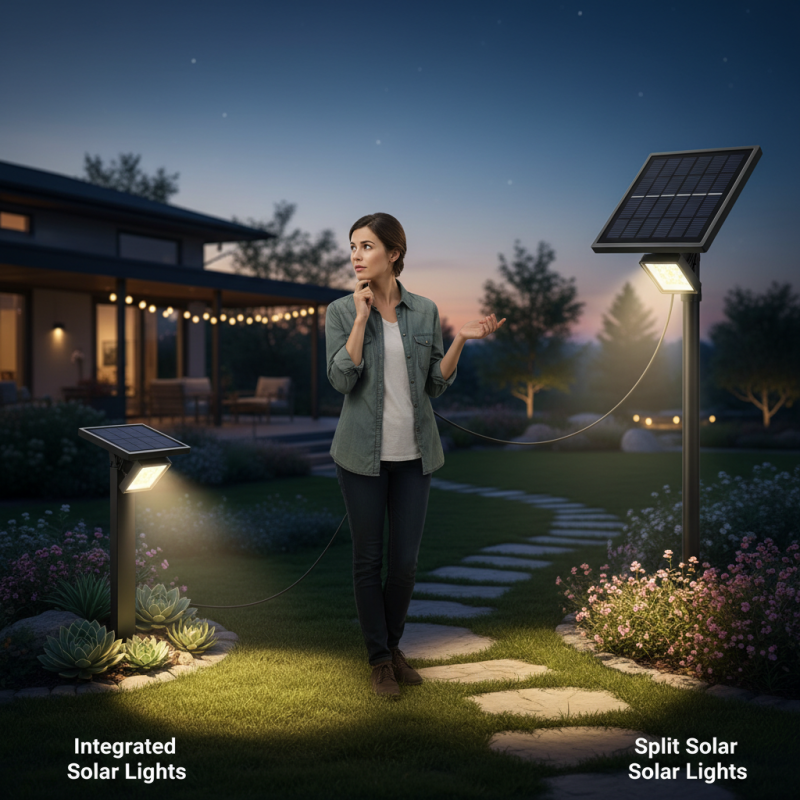
When pondering "How to choose between integrated and split solar lights?" it is important to evaluate your environment. Integrated lights combine solar panels and fixtures. They are often compact and easy to install. However, this can limit flexibility in placement and brightness.
In contrast, split solar lights feature separate solar panels and lights. This design allows for greater versatility in positioning, which can enhance lighting coverage. Choosing between the two depends on your installation space and desired brightness. Reflecting on your actual needs can help simplify your decision-making process.
Understanding Integrated Solar Lights and Their Benefits
Integrated solar lights have gained traction for their compact design and ease of use. These lights come with solar panels, LED lights, and batteries built into one unit. This design allows for quick installation and reduced maintenance. By harnessing solar power, they provide energy-efficient lighting. They are especially suitable for areas without access to traditional electricity.
Tips: When choosing integrated solar lights, consider the brightness you need. Light output varies by model. Also, check the battery capacity; it affects how long the light lasts at night. Ensure that the light you choose is weather-resistant. This feature enhances durability and performance in different climates.
Though integrated solar lights offer many advantages, they may not be suitable for every location. Their performance can be hampered by prolonged cloudy weather. Additionally, the fixed solar panel angle may reduce charge efficiency throughout the year. It's essential to evaluate your specific needs and environment carefully before making a decision.
Exploring Split Solar Lights and Their Unique Advantages
When considering outdoor lighting, split solar lights offer unique benefits. Unlike integrated solar lights, split models separate the solar panel from the light fixture. This design allows for greater flexibility in installation. You can place the solar panel in a sunny spot, while the light illuminates shaded areas. It’s a sensible approach when dealing with gardens or pathways that receive varying sunlight.
One advantage of split solar lights is their efficiency. With the solar panel positioned optimally, they recharge faster. This means brighter lights and longer-lasting performance at night. Furthermore, the ability to adjust the panel can lead to greater energy savings. If you live in an area with limited sun, this feature is crucial.
Before purchasing, consider installation tips. Ensure the solar panel captures maximum sunlight during the day. Check for obstructions like trees or buildings nearby. Additionally, look for lights with adjustable brightness settings. They provide flexibility for different occasions. Split solar lights can enhance your landscape while being conscious of your energy needs. Choose wisely to gain the best outcome from your lighting investment.
Comparison of Integrated and Split Solar Lights
This chart compares the average energy efficiency between integrated solar lights and split solar lights. Split solar lights typically offer higher energy efficiency, making them a preferred option for various outdoor lighting needs.
Comparative Analysis: Integrated vs. Split Solar Lighting Solutions
When considering outdoor lighting, the choice between integrated and split solar lights can significantly impact functionality and aesthetics. Integrated solar lights combine all components into a single unit. This design simplifies installation and reduces upkeep. According to the Solar Energy Industries Association (SEIA), integrated systems can perform effectively in areas with limited sunlight due to their efficient energy management. However, their fixed design can limit flexibility.
On the other hand, split solar lights separate the panel from the fixture. This allows for optimal panel positioning to capture sunlight. The split design can increase efficiency by 20% in partially shaded areas. Users have reported better performance in certain environments, reflecting the adaptability of this model. However, this can lead to more complex installations and potential maintenance challenges.
Tips: When choosing solar lights, assess the available sunlight in your area. Check the dimensions for installation spaces. Always think about how comfort and safety play into your outdoor lighting needs. Not all designs suit every landscape. Each option presents unique pros and cons that must be weighed. Be prepared for possible inefficiencies with certain models, prompting a critical look at your choices.
Factors to Consider When Choosing Between Integrated and Split Solar Lights
When considering solar lighting, the choice between integrated and split systems is crucial. Integrated solar lights have all components built into one unit. They are often easy to install and require minimal maintenance. Reports indicate that these lights tend to be more reliable in performance. According to industry data, they can provide up to 30% more efficiency in energy conversion compared to split systems.
On the other hand, split solar lights consist of separate panels and lights. This design allows for flexibility in placement, particularly in areas with shade. A study highlighted that split systems can enhance light distribution, making them suitable for larger spaces. However, installation can be more complex, requiring careful planning and additional mounting equipment. Understanding the specific lighting needs of your environment is vital.
Environmental conditions can affect performance. In regions with heavy cloud cover, integrated units may underperform, while split systems can be positioned to optimize sunlight exposure. Ultimately, analyzing energy consumption and lighting requirements will help make the right decision. It's important to weigh the pros and cons, as each option has unique advantages and challenges.
Why Choose Integrated or Split Solar Lights for Your Needs?
| Feature |
Integrated Solar Lights |
Split Solar Lights |
| Installation |
Easy to install; typically require less setup time. |
Might require more setup due to separate components. |
| Cost |
Generally lower initial cost. |
Higher initial investment due to separate parts. |
| Maintenance |
Typically low maintenance; all parts are in one unit. |
May require more frequent maintenance of individual components. |
| Brightness |
Often less bright than split systems. |
Can offer higher brightness due to larger panel size. |
| Versatility |
Limited to their design; not adjustable. |
More versatile; can place the solar panel in optimal sunlight. |
| Lifespan |
Generally long-lasting but limited by integrated components. |
Can have a longer lifespan due to replaceable parts. |
Real-Life Applications and Scenarios for Integrated and Split Solar Lights
Integrated and split solar lights serve distinct roles in various real-life applications. Integrated solar lights, with built-in solar panels and batteries, provide a compact solution best for pathways and gardens. According to the Solar Energy Industries Association, integrated models often have a lower upfront cost. They are energy-efficient and require minimal setup.
On the other hand, split solar lights offer flexibility. The solar panel can be installed in a sunny location, while the light fixture can be mounted in shaded areas. This feature is particularly useful in urban settings or landscapes with trees. A report from the National Renewable Energy Laboratory indicates that split systems can improve overall efficiency by 30%. Users often find it challenging to decide based on their unique setup and energy needs. The variance in brightness and longevity can lead to reflections on installation choices.
Choosing the right type also depends on specific lighting needs. For example, floodlights may demand higher brightness for security applications. Integrated lights may not always meet these requirements adequately. In contrast, split designs allow users to select higher wattage for illuminating larger areas. Balancing efficiency, application, and installation hurdles is essential for achieving optimal lighting solutions. These practical details often lead consumers to reconsider their choices.
FAQS
: Integrated solar lights combine solar panels, LED lights, and batteries into one unit. They are user-friendly.
Light output varies widely. Evaluate your specific needs and select based on desired brightness levels.
Yes, but you should check for weather resistance. This feature enhances durability significantly.
They may struggle in prolonged cloudy conditions. Performance can be notably affected by weather.
Split solar lights allow for better panel positioning. This design can increase efficiency by about 20% in shaded areas.
Yes, integrated lights simplify installation. They require minimal maintenance as well.
Assess available sunlight and space dimensions. Placement can greatly affect lighting effectiveness.
Yes, areas with heavy cloud cover can reduce integrated lights' efficiency, unlike split systems.
Weigh unique pros and cons of each option. Understand your lighting requirements carefully for the best choice.
Users report better performance in certain environments, highlighting their flexible installation options.
Conclusion
When deciding how to choose between integrated and split solar lights, it's essential to understand the distinct features and benefits of each option. Integrated solar lights combine the solar panel and lighting fixture into a single unit, making them simpler to install and often more aesthetically pleasing. On the other hand, split solar lights offer flexibility, as the solar panel can be positioned separately from the light source, allowing for optimal sun exposure and illumination placement.
A comparative analysis of both lighting solutions reveals that the choice largely depends on specific needs and scenarios. Factors such as installation requirements, space, and desired lighting performance should guide your decision. Real-life applications demonstrate that integrated solar lights are ideal for streamlined designs in smaller areas, while split solar lights excel in expansive spaces where customization is key. Ultimately, weighing these elements will help you determine the best fit for your solar lighting needs.

 Penelope Light